Understanding Knitted Fabric OEM Service: What Apparel Manufacturers Should Know Before Sourcing
The Real-World Challenges Behind OEM Knitting
For many clothing manufacturers, fabric sourcing remains the most unpredictable part of production. A small shift in yarn tension can alter GSM and stretch recovery; inconsistent dye lots lead to mismatched tones; delayed sampling can disrupt launch calendars. These are not rare accidents — they are the daily risks of working with unstructured supply chains.
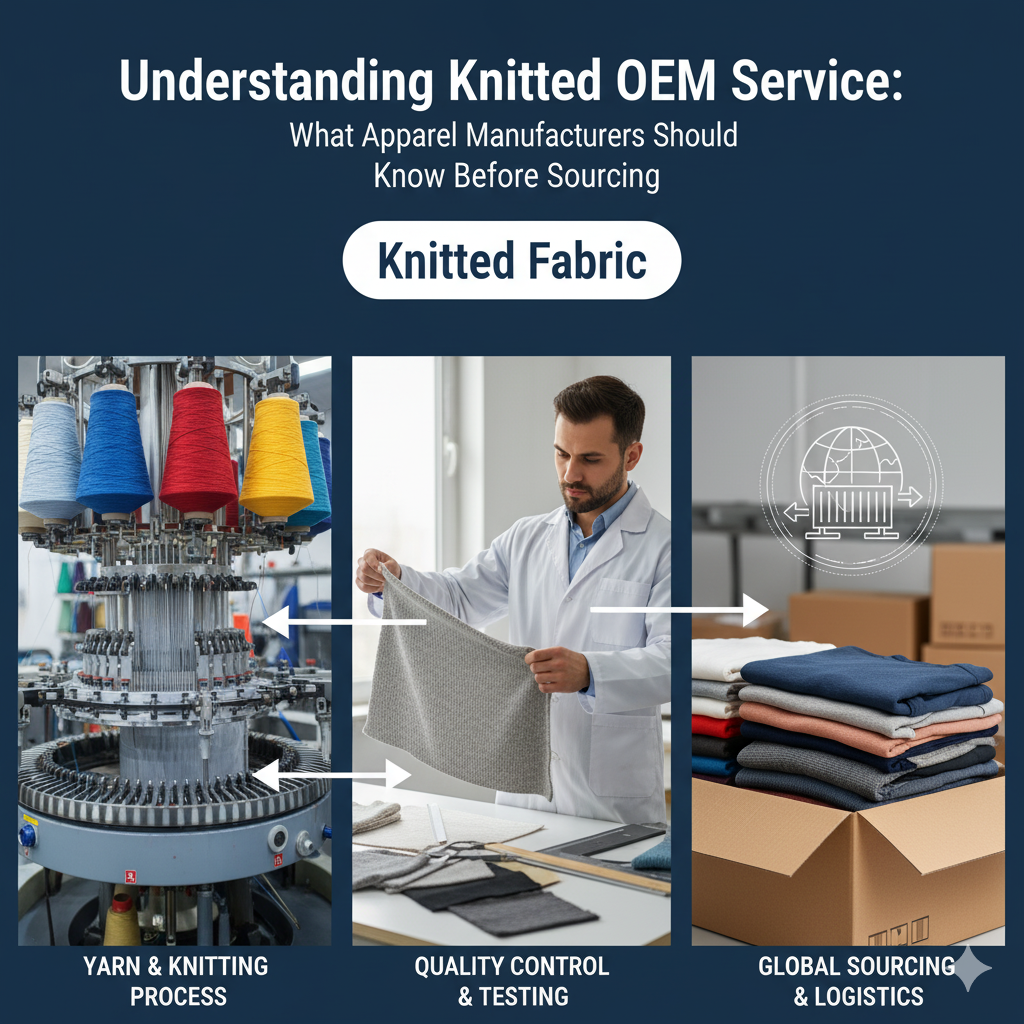
An effective knitted fabric OEM service is meant to reduce these uncertainties. But “OEM” alone guarantees nothing. The key lies in whether the supplier controls each variable — yarn, knitting, finishing, and testing — under a unified system.
How Knitted Fabric Quality Is Really Made
Knitting quality depends less on machinery and more on parameters often invisible to buyers:
-
Tension Balance: Slight changes create variations in density and feel.
-
Gauge and Loop Design: Determines elasticity, weight and drape.
-
Finishing Process: Brushing, compacting or bonding dramatically affect final handfeel.
-
Quality Checks: Ongoing inspection for shrinkage, colorfastness, and pilling resistance prevents costly rework later.
Understanding these factors helps sourcing teams ask the right questions — not just about price, but about reproducibility.
Comparing In-House OEM Knitting vs. Multi-Vendor Sourcing
| Criteria | In-House OEM Knitting | Multi-Vendor Model |
|---|---|---|
| Consistency | Controlled under one production line | Variations between subcontractors |
| Communication | Single technical contact | Multiple intermediaries |
| Development Speed | Faster sampling cycles | Delayed approvals |
| Traceability | Full yarn-to-roll record | Often incomplete |
| Long-Term Cost | Predictable | Hidden losses from defects |
Centralized OEM knitting may seem more expensive at first, but the real economy comes from reduced rework and steadier replenishment.
Why the Right OEM Structure Saves Time and Cost
A reliable knitted fabric OEM service operates more like a partnership than a vendor relationship. The process usually includes:
-
Requirement Definition – Specifying GSM, fiber composition, finish type, and shrinkage limits.
-
Sampling with Real Parameters – Samples come from actual production settings, not lab-scale tests.
-
Performance Verification – Tests for wash shrinkage, pilling, and elasticity before mass production.
-
Controlled Scaling – Bulk production uses identical machine settings and yarn batches to preserve stability.
When each stage communicates with the next, brands gain control over timing and avoid the “perfect sample, unstable bulk” problem common in textile sourcing.
Key Advantages for Manufacturers and Designers
-
Predictable Fit and Sewing Behavior: Fabrics with stable shrinkage and stretch properties reduce pattern adjustment costs.
-
Design Freedom: Knitted structures (jersey, interlock, bonded) can be tuned for weight, elasticity and surface feel without changing the main yarn.
-
Faster Reaction Time: OEM systems allow rapid turnaround from prototype to shipment, ideal for short-season collections.
-
Lower Long-Term Waste: Consistency reduces rejected rolls, which lowers per-unit cost even when initial pricing is similar.
-
Traceable Data: Batch-level documentation supports quality audits and compliance requirements.
These are not marketing claims — they are measurable benefits that directly influence lead time, fabric yield and production reliability.
Practical Applications of OEM Knitted Fabrics
| End Use | Suitable Structure | Functional Target |
|---|---|---|
| Casualwear & T-shirts | Jersey | Softness, stretch and comfort |
| Activewear | Interlock | Dimensional stability and recovery |
| Winterwear Linings | Bonded Knit | Warmth with reduced bulk |
| Home Textiles | Heavy Jersey | Form retention and tactile appeal |
| Babywear | Fine Interlock | Gentle touch and safety compliance |
Selection Tips for Buyers and Sourcing Managers
-
Check GSM Variance: Reliable OEM partners provide ±3% control.
-
Inspect Stitch Density: Ask for knitting gauge details to assess structure consistency.
-
Request Wash Test Reports: True performance shows only after multiple wash-dry cycles.
-
Evaluate Communication Efficiency: Fast feedback often predicts reliable delivery.
-
Confirm Reproducibility: Ensure the supplier can replicate identical batches across months or years.
The difference between a smooth season and a delayed launch often comes down to these verification steps.
Frequently Asked Questions
Q1: What’s the minimum quantity for knitted fabric OEM production?
Low-MOQ sampling is available; bulk runs start once parameters and finishes are approved.
Q2: How can I test consistency before large orders?
Request two identical sample rolls produced in separate sessions — if they match, tension control is stable.
Q3: Are bonded knit fabrics suitable for apparel?
Yes, especially for outerwear or loungewear needing warmth without extra layers.
Q4: What’s a realistic timeline for OEM fabric production?
Sampling takes around 7 days; full production typically 25–30 days depending on fabric type and finishing.
Choosing OEM Partnerships That Reduce Uncertainty
The value of a knitted fabric OEM service lies not in price, but in predictability. When yarn sourcing, knitting, finishing and testing align within one managed system, brands gain time, stability and peace of mind.
Whether you produce activewear, everyday basics or soft furnishings, understanding these mechanisms helps you select partners who deliver fabrics that perform consistently, season after season.
For detailed fabric categories or technical consultation, visit our homepage or reach out via the contact page.